The Question Of Innate Talent

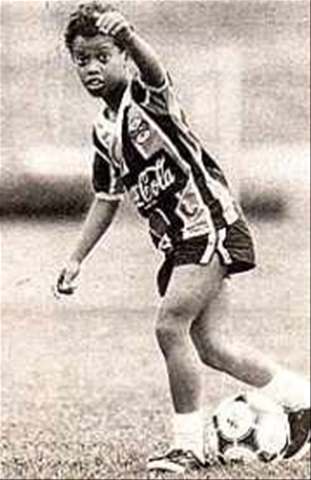
From http://www.v-brazil.com/culture/sports/football/player/ronaldinho-kid.jpg Recently while picking up a few items at Target, I decided to buy a cheapo soccer ball. Now those who know me know I’m a bit of a fanatic about playing soccer, willingly paying good money for a quality ball.

But this ball is not for playing outdoors. I keep it in my office so I can dribble it during breaks, deftly avoiding obstacles on my way to the bathroom, practicing moves during phone calls and long compilations.

It’s a minor thing, but I am already noticing improvement when playing for real, just through the benefits of visualization and practice. I wouldn’t recommend this for every sport. Images of Craig Andera with a hockey stick breaking furniture in his office come to mind.

As software developers, we tend to hold the idea of innate talent in very high regard. How often do you hear software pundits saying, Either you got it, or you don’t.

However, according to a recent Scientific American article, The Expert Mind, this may not be as much the case as we think.

At this point, many skeptics will finally lose patience. Surely, they will say, it takes more to get to Carnegie Hall than practice, practice, practice. Yet this belief in the importance of innate talent, strongest perhaps among the experts themselves and their trainers, is strangely lacking in hard evidence to substantiate it.

The article delves into studies of chessmasters who when briefly shown a random chessboard cannot recall the positions of its pieces any better than non-chessmasters, but when those pieces represent possible configurations due to game play, have a significantly stronger recall.

The article concludes that chessmasters build structures in their brains to recognize patterns in chess, and that to become an expert in chess takes around ten years.

The one thing that all expertise theorists agree on is that it takes enormous effort to build these structures in the mind. Simon coined a psychological law of his own, the 10-year rule, which states that it takes approximately a decade of heavy labor to master any field. Even child prodigies, such as Gauss in mathematics, Mozart in music and Bobby Fischer in chess, must have made an equivalent effort, perhaps by starting earlier and working harder than others.

It turns out that the quality of effortful study is a big factor in moving from novice to expert. So not everyone will become an expert in 10 years, only those who continue to push themselves, examine their weaknesses and strengths, and study accordingly.

I figured I could move past my plateau as a soccer player by creating ways to practice better and more often, hence the soccer ball in my office.

I think the lesson for software developers who wish to keep on top of their game and become experts is to keep exercising the mind via effortful studying. I read a lot technical books, but many of them aren’t making me better as a developer. I pretty much read books on autopilot these days.

It’s not till I actually spend time to think about the implications and applications for concepts in the books, explain these concepts to others, and write code to test my understanding out, that I really feel growth in my craft.

Of course, that leaves me with the question of whether some people are innately more curious or better at studying and finding ways to improve themselves, but that’s a question for the researchers to work on.

If you haven’t already, I recommend reading the article, because my summary does not do it justice.

What others have said

Requesting Gravatar... Rob Conery Dec 05, 2006 11:57 AM
# re: The Question Of Innate Talent
I think the "Have it" part goes more towards the traits lending to the skill, rather than the actual skill itself.

One of the more "interesting" personalities in our CSK community was a guy named Rafal who would post messages to our board at the rate of about 1 per 20 minutes - often having a conversation with himself on certain problems. He was by an order of magnitude our most prolific poster.

I read up his bio and also a little more on his personal site and it turns out he's a chess grand champion, and his dominant talent is a single-minded intensity towards his goal - often wearing down his opposition with his relentless strategy.

I saw this "intensity" daily on our forums and while it was a bit of a "challenge", I admired it. I remember thinking that if you pointed this kid's nose in the right direction, he could do some real good work.

To me, if you mix and match certain traits you have the makings of an "expert". Perhaps a dash of rebelliousness (for kicking the norm to the curb), a heavy dose of tenacity, and a flamingly curious mind gently baked over 10 years...

This gets even more fun as you watch these things develop in childhood. I have two wonderful kiddos and it sure is fun to see the differences - all from genetics! I'm convinced that my oldest daughter will be a mathematician and my youngest will be prom queen :).
Requesting Gravatar... Mike Swaim Dec 05, 2006 12:14 PM
# re: The Question Of Innate Talent
Ability is a negative qualifier. I've known people who should not be programmers. (And they weren't, thank goodness.)
For programmers, one of the things I look for has been whether or not the person likes playing with technology and seeing how things work. If they have that techie spirit, it's a good sign. That means that they'll develop the skills they have and add new new ones because it's fun. Otherwise, you'll get someone who's competent, but probably won't grow much.
Requesting Gravatar... Kevin Dente Dec 05, 2006 12:28 PM
# re: The Question Of Innate Talent
Perhaps there's hope for my inconsistent -as-hell tennis game after all. :)
Requesting Gravatar... Craig Dec 05, 2006 12:36 PM
# re: The Question Of Innate Talent
Yes, indeed, my wife frowns on hockey practice inside the house.

Interesting that you found ten years to be the duration. Here's something I wrote about two years ago:

http://pluralsight.com/blogs/craig/archive/2004/06/08/1450.aspx

The question I have is, what shall we call this unit? Ten years = "1 expert"? A "Haackochron" ? :)
Requesting Gravatar... Haacked Dec 05, 2006 1:33 PM
# re: The Question Of Innate Talent
Well it wasn't me that came up with 10 years, but the research referenced in the article that found 10 years to be the sweet spot. Seems to be a consensus on that, if your post is any indication.
Requesting Gravatar... Rush Dec 05, 2006 4:15 PM
# re: The Question Of Innate Talent
Ya I have a soccer ball I just dribble inside. It makes trips to the bathroom much more fun. w00t!
Requesting Gravatar... Jeff Atwood Dec 05, 2006 4:17 PM
# re: The Question Of Innate Talent
Ability makes you good, but desire is what makes you great.

If you want to build a ship, don't drum up the men to gather wood, divide the work and give orders. Instead, teach them to yearn for the vast and endless sea.
Requesting Gravatar... Rob Conery Dec 05, 2006 7:26 PM
# re: The Question Of Innate Talent
Bah! Desire is a silly 80's song by two weird twins dressed like Pinatas. Like the song, desire is iconic of the 80's anyway :). Tony Robbins can only get you so far!

Seriously though, I've knows people who really, really wanted to do well at development and just had no... "there" there. There are just some blocks that must remain uncut.
Requesting Gravatar... Jon Galloway Dec 05, 2006 11:45 PM
# re: The Question Of Innate Talent
It's interesting to see Jon Udell discussing the same basic question - innate talent vs. learned skill - in context of web searching:
http://weblog.infoworld.com/udell/2006/12/04.html#a1571

Sure, we can bring an understanding of boolean logic and how search engines work to the table, but at the end of the day a lot of it is a learned skill through trial and error.
Requesting Gravatar... Scott Dec 06, 2006 9:06 AM
# re: The Question Of Innate Talent
Ah, so if I start training my 1 year old now, by the time she is ten she'll be a physicist?

No, of course not. That's ridiculous. But, if I put her in a language class, with a native speaker, she'll end up being fluent in less than 10 years and with no traceable accent. If I take the same class, I'll still have an accent in 10 years. There are certain ages and time frames, early years for languages, middle years for math, late teens for physical activity, that make it much easier to become an expert. Then there is the tick, tick, ticking of the clock in our bodies. Generally, your brain gets softer the older you get (literally, look it up! ;) ) and so does your body. Making it more difficult to do the same things you could in your youth. Think Michael Jordan could beat the best college player today? Maybe, think he could in 10 years? Probably not.

Eh, I'm gonna leave it at that. I'm too old for this kind of mental activity. ;)
Requesting Gravatar... Haacked Dec 06, 2006 9:25 AM
# re: The Question Of Innate Talent
> Ah, so if I start training my 1 year old now,
> by the time she is ten she'll be a physicist?

No, you'l have to wait till she's 11 because it takes 10 years, not nine. ;)
Requesting Gravatar... Ryan Smith Dec 06, 2006 1:25 PM
# re: The Question Of Innate Talent
I think it has less to do with innate talent and more to do with personality. I know a lot of people that are much smarter than me - at math, science, English, just about every field you can imagine. However, there is no way they could ever become a programmers.

Why not? Is it because I don't think they could learn the syntax or data structures? The basic logic? No, it's simply a lack of desire to do so.

Being able to remain focused while staring at a computer screen all day reading symbols like they were a literary masterpiece is a unique trait. You have to appreciate and like what you do in order to be any good at it.
Requesting Gravatar... Walt Dec 07, 2006 4:22 PM
# re: The Question Of Innate Talent
I left this comment on the lesser known phil.haacked.com, little did I know all of the other responses were on the "technical blog."

Phil, you write that "it turns out that the quality of effortful study is a big factor in moving from novice to expert. So not everyone will become an expert in 10 years, only those who continue to push themselves."

Sounds plausible. However, I have a feeling the quality of a person's innate ability probably also has a lot to do with it.

It may take 10-years to develop an expertise, but I doubt very much that anyone can develop an expertise in a given field merely by putting sufficient "effortful study" into it for 10-years. I beleive some people have the skills or talent necessary to become an expert in 10 years (or less, with or without effortful study), others can put in the same effort or more for a longer period of time with little result.

As for child prodigies, they become prodigies far younger than 10 years old, and I doubt very much they somehow squeaze 10-years of effort into the 4 - 9 years of their young lives (see articles below). The child who was attending Julliard at age 10 and wrote 5 symphonies by the time he was 13 years old says he hears multiple channels of music in his mind's ear. I doubt you or I could pull this off after 10 years of study, no matter how effortful.

So Phil, you not be playing in the World Cup after 10 years of practicing with your new soccer ball at home, on the other hand, your skill at programming may be due to more than "efforful study." Thank Mom and Dad.

http://www.cbsnews.com/stories/2006/11/22/60minutes/main2205521.shtml

http://www.cbsnews.com/stories/2005/07/11/60II/main708142.shtml
Requesting Gravatar... The Heinrich Maneuver Mar 08, 2007 8:51 AM
# Thinking
Thinking

What do you have to say?

(will show your gravatar)
Please add 3 and 5 and type the answer here: